Profitability cases: beyond the formula
What to do after you write Profit = Revenue - Costs on your scratch paper

|
|
Why firms use profitability cases | A simple MECE approach | How strong candidates differentiate | A tale of two frameworks | Practice drills | Full profitability cases
If you go through multiple rounds of consulting interviews, you will encounter at least one profitability case. This problem type is very common, accounting for more than 35% of all tracked cases. The challenge: "straightforward" does not always mean easy, and interviewers have seen thousands of candidates recite the same formula. This post covers what to do after you write "Profit = Revenue - Costs" at the top of your scratch paper, as well as some thoughts on the "game behind the game" during case interviews that are especially apparent when every single candidate starts a case already knowing the "right" answer.
Why firms use profitability cases (Top)
Let's start with the basics. "Profitability" is an esoteric, six-syllable word that dresses up the purest, most fundamental question that every business has faced since the beginning of time: how do we grow profit?
In practice, a profitability question might look like any of the following:
- How do you make more money at your merch stand if t-shirts cost you $15 to acquire, and customers buy them for $20?
- You run a chain of restaurants with four locations. Three of them net $10k/month in profit, while one is losing $500 per month. How do you solve this problem?
- Should Costco sell hotdogs for $1.50 if it costs them $2 to serve it?
- Strava has been growing for years with free users, but now wants to increase profit. How do they do this?
Firms use this case because it is the most fundamental business question there is. Regardless of industry, a business needs to net money to survive.
From a candidate evaluation standpoint, it is the opposite of a trick question. You and the interviewer will look at the fundamentals of a business to see if you can figure out how to make more money. It is a wide open field to do some math, consolidate information, and build conviction on what to do. Just about everybody who interviews at MBB, tier 2, and boutique firms will know that Profit = Revenue - Costs.
What impresses interviewers is what you do with this type of case. Candidates who view case interviews as an academic quiz might parrot back the formula and spout off random ideas to grow revenue or cut costs. Stronger candidates will work with the given data and the interviewer to build and communicate clear conviction in the client's path forward.
A simple MECE approach to profitability questions (Top)
The most reliable framework to solve profitability questions is the simple function mentioned above:
Profit = Revenue - Cost
Using this equation does more than give you a starting point. It guarantees that your structure is complete. If profit is declining, then revenue must be falling, costs must be rising, or both.
From there, you can expand the function one level deeper:
- Revenue is typically a function of price and quantity.
- Costs are typically split into fixed and variable components.
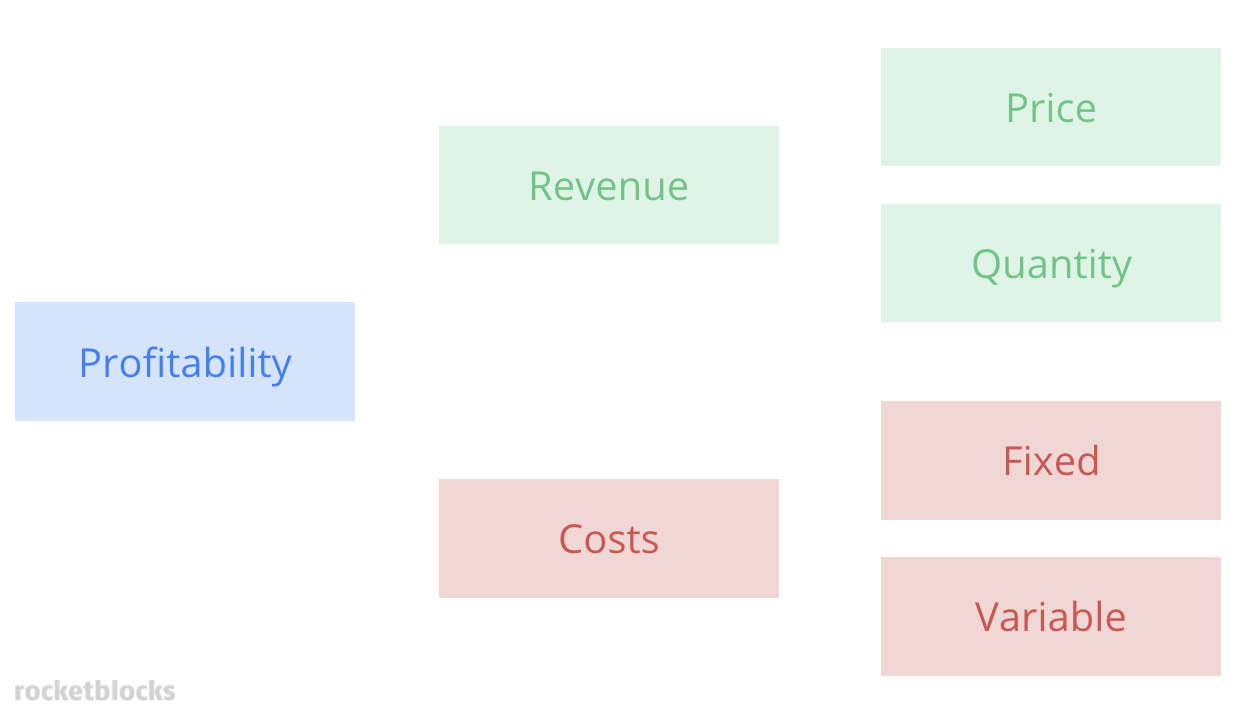
This creates a clean, logical map of the business you can use before diving into details. The excerpt below, from our Structuring concept (subscription required), shows this MECE approach applied to a real example:
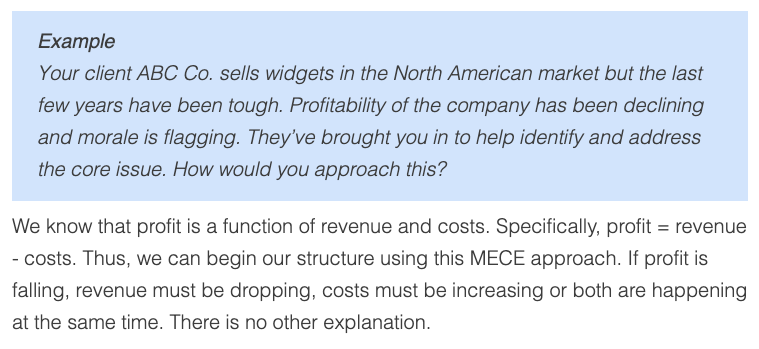
For a deeper walkthrough of common profitability case patterns and how interviewers tend to frame them, see our overview of profitability case questions.
💡 Shameless plug: Our consulting interview prep can help build your skills
How strong candidates differentiate (Top)
The structure itself is simple. The insight comes from how you adapt it to the problem at hand given the data you discover in the case.
Strong candidates differentiate themselves in how they handle variations on the basic structure. Revenue is not just price × quantity. It might also involve product mix, customer segments, or channels. Costs are not just fixed vs. variable. They may include step costs, new investments, or utilization effects.
And most importantly, the prompt almost always contains clues. If the case mentions a new product, think about mix. If it mentions expansion, think about capital investment or complexity. If it references competition, consider pricing pressure.
This is the game behind the game in profitability cases: the framework is table stakes. What separates strong candidates is the ability to read the case's specific context, adapt the structure accordingly, and use the data to build a clear, evidence-based point of view on what is actually driving the problem.
A tale of two frameworks (Top)
Consider this prompt: Your client is a regional gym chain that has seen profits decline over the past two years despite steady membership growth.
The mediocre response starts with the formula and stays there:
"I'd like to look at this through a revenue and cost lens. On the revenue side I'd explore price and quantity. On the cost side I'd look at fixed and variable costs."
Technically correct. But it tells the interviewer nothing about whether the candidate understands the business or could advise on it. Membership is growing but profits are declining. That's a specific and important clue that the candidate has ignored entirely.
The strong response uses the profitability framework to add specific context from the prompt and from the candidate's own business knowledge:
"The interesting tension here is that membership is growing but profits are falling. Which suggests this is less likely to be a volume problem and more likely to be a revenue quality or cost structure issue. On the revenue side, I'd want to understand whether the mix of membership types has shifted, for example, towards lower-tier or discounted plans. On the cost side, I'd focus on whether costs are scaling faster than membership growth, particularly fixed costs like leases or staffing, which wouldn't flex down easily if revenue per member is falling."
Both answers have the same underlying formula (profit = revenue - costs). But the strong candidate has used the prompt's clue and their knowledge of how a gym chain would make money to immediately narrow the space.
Practice with profitability drills (Top)
Reading concepts builds understanding but, as always, performance improves through practice. To build real fluency, you want repetition in structuring, brainstorming, analyzing, and quantifying profitability. When you complete drills on RocketBlocks, your responses are compared to Expert answers with feedback on how well you verbalized chart analysis and frameworks.
Here is a sampling of drills to sharpen your profitability skills:
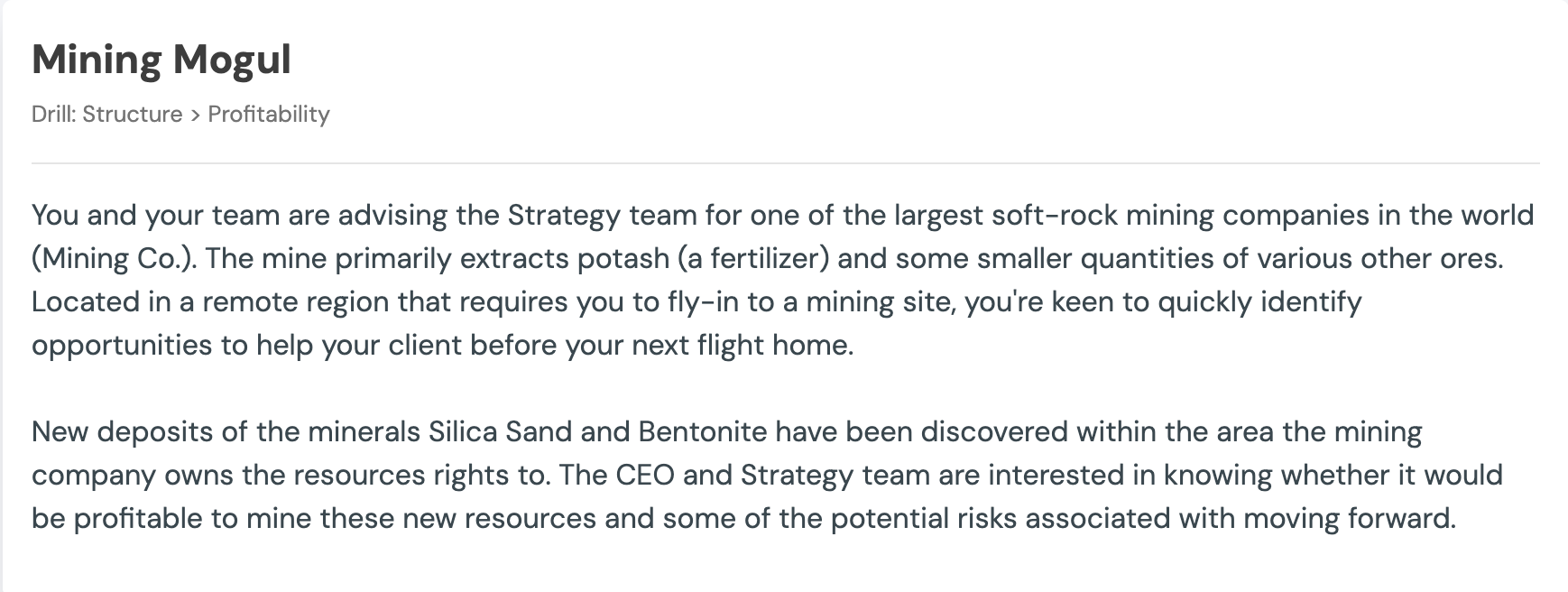
Structure drill: Mining Mogul — Help one of the world's largest soft-rock mining companies assess the profitability and identify the risks of mining new materials recently discovered on company-owned land.
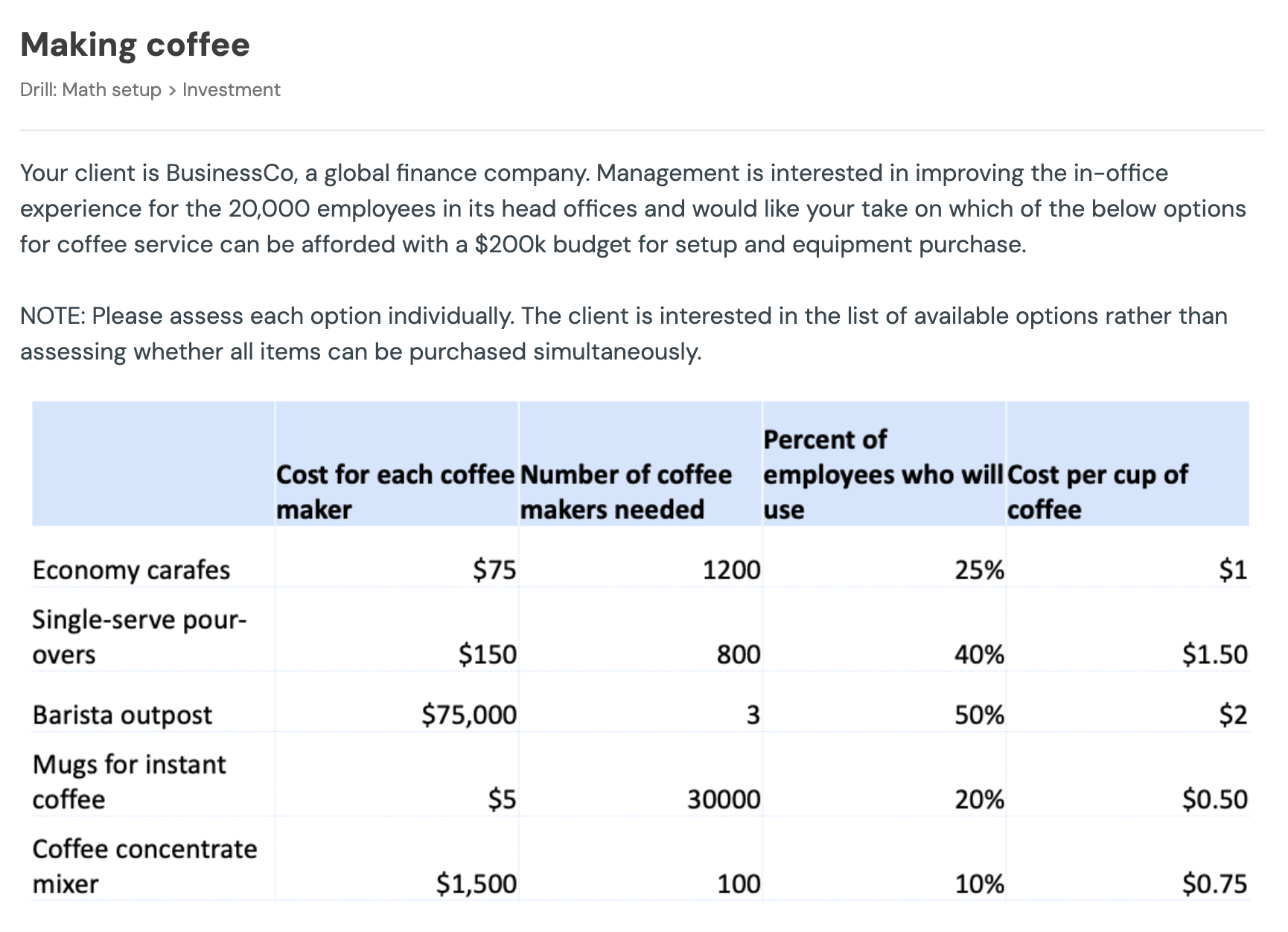
Math drill: Making coffee — A global finance company wants to improve its in-office experience at main locations. Help the company identify the best options within their $200K budget.
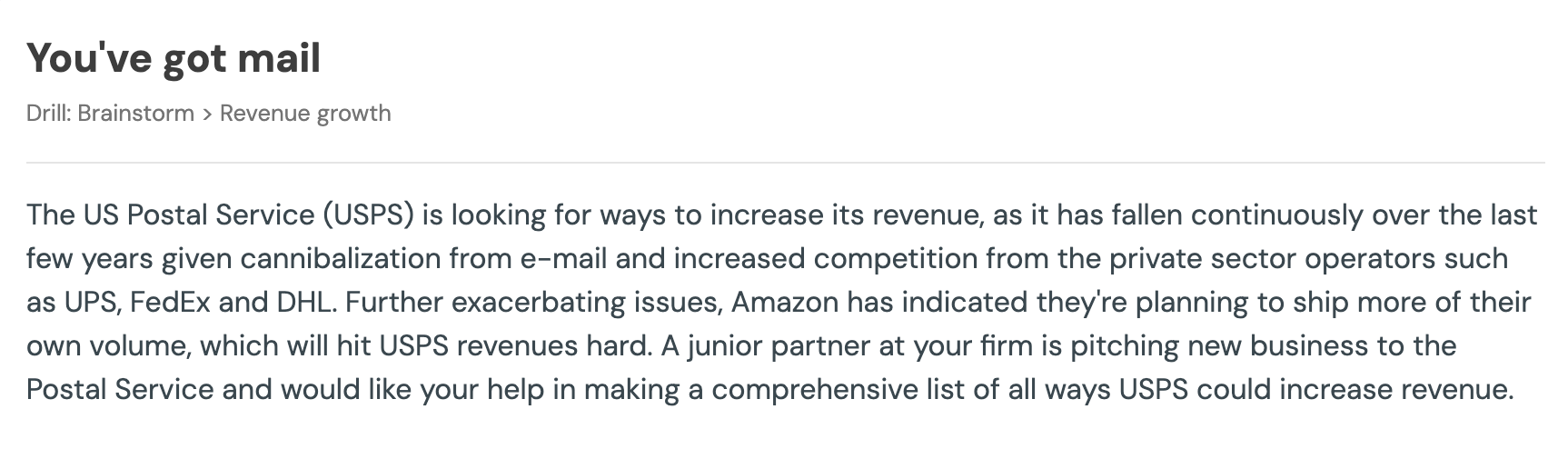
Brainstorm drill: You've got mail — Help the United States Postal Service increase revenue amidst increased competition from the private sector.
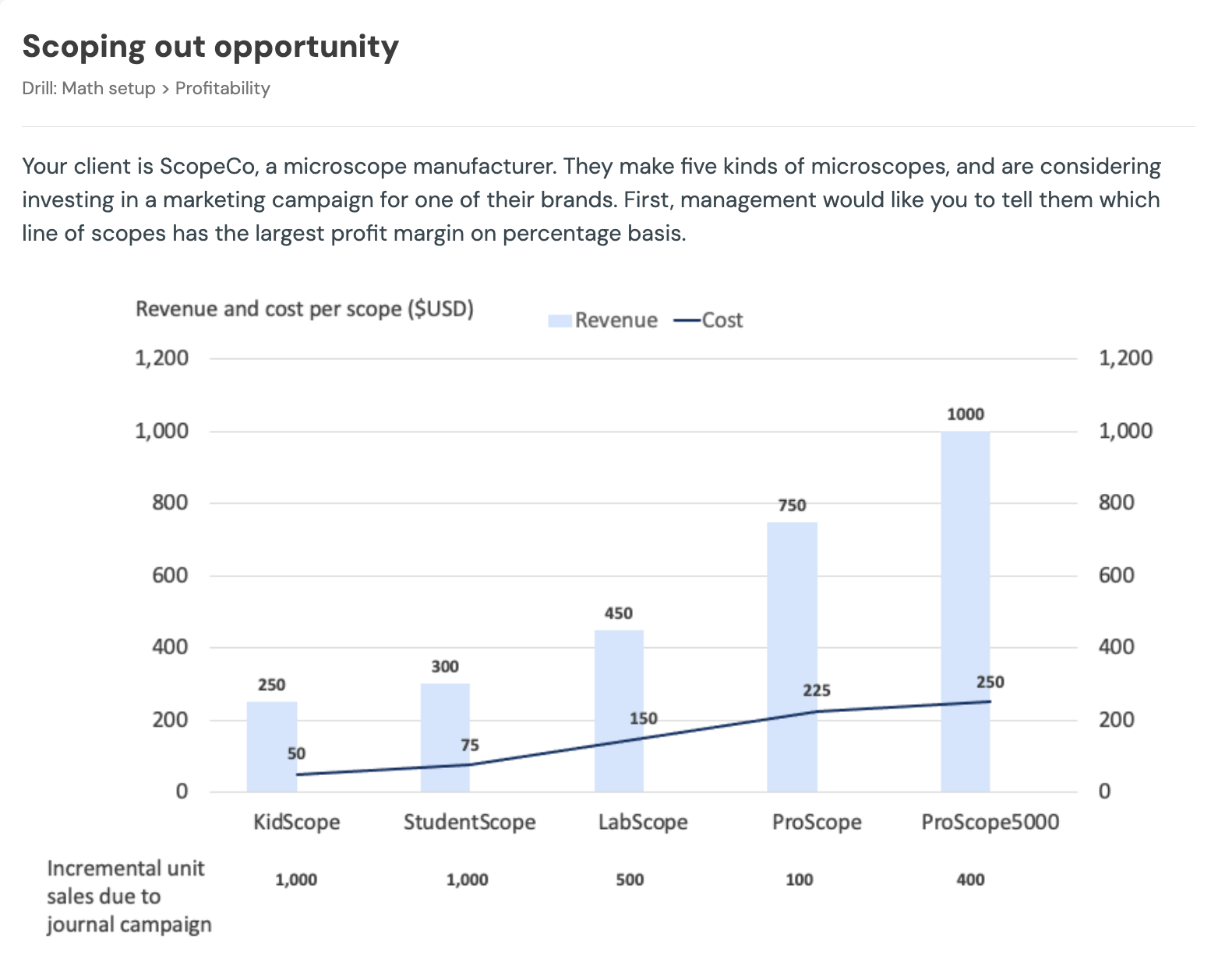
Charts drill: Scoping out opportunity — Help a microscope manufacturer determine which product line has the biggest profit margin percentage-wise.
Full profitability cases (Top)
Once you have worked through a few drills, the final step is seeing how this logic plays out in a full case conversation. Drills build the muscle in isolation. A mock interview shows how those muscles connect under real pressure.
Head to RocketBlocks' case library to find all our full profitability cases:
Here are four cases to get started:
- Marathon Monday is designed with beginners in mind. Help the Consulting Club at Charles River University understand declining merch sales and boost profits during its annual fundraiser, which takes place during the Boston Marathon.
- Shipwrecked margins is a McKinsey-inspired case. Help Harborlink Ports, a commercial seaport facing declining profitability, identify the cause of the decline at one of its ports despite stable traffic to the region. Volumes are changing, costs are rising, and leadership wants a clear, corrective course for both the short and long term.
- McDonald's meal deal asks you to help the world's largest fast food chain decide whether to place profit at the head of its strategy or maintain a growth-over-profit stance, keeping its $5 value meal on the menu.
- Seats of Change is based on Southwest Airlines' recent announcement that they would move away from a key aspect of their ticketing strategy. Help Northeast Airlines decide whether or not to move to assigned seating and premium seating upgrades, factoring in both potential revenue and customer backlash.
Read this next:
- Full cases from RocketBlocks
- The MECE principle
- Be a great mock interview partner
- How to build mental math skills
- Mock interview grading templates
- Example case interview prep plans
- Be authentic: advice from a Bain Consultant
- Don't be that candidate
- The Skill Building Loop for case interviews
- Recover from a math error
- Conclude a case interview well
- Acing Accenture's interview process
- How to use RocketBlocks
- Asking great questions in consulting interviews
- How to prep for fall consulting recruiting over the summer
- How to analyze charts in your consulting interview
- How to build CPG industry knowledge
P.S. Are you preparing for consulting interviews?
Real interview drills. Sample answers from ex-McKinsey, BCG and Bain consultants. Plus technique overviews and premium 1-on-1 Expert coaching.


