How to build mental math skills for consulting and tech interviews

|
|
Why firms test math | Three-step sequence | Deliberate practice | Step 1: Benchmark | Step 2: Setup | Step 3: Calculation | Step 4: Insights | Conclusion
Case math is the monster under the interview bed.
We've worked with the strongest candidates across four continents, and the one thing we're asked to help with most often is math. So many people feel intimidated by quantitative sections, or at the very least they lack confidence in their numerical abilities.
In this guide, we'll address this challenge head-on and give you a structured approach to mastering the most intimidating part of your case interview.
Why firms test math skills (Top)
Before diving into tactics, it's essential to understand why math is a fundamental part of consulting and tech interviews. Why do firms care if candidates can do percentages mentally? We live in an AI-powered world where Microsoft Excel just turned 40 years old—so how is mental arithmetic relevant when machines can handle these calculations for us?
The reason is straightforward: Candidates who excel at mental math tend to be exceptional at quickly debunking, proving, and sanity checking hypotheses. Business conversations and problem-solving move rapidly, and successful leaders need to grasp key numbers on the fly. You can't pause a client meeting to open Excel and write formulas to determine if high-level ideas are plausible.
Understanding this rationale should inform how you build your math skills before your interview. If you narrowly view quantitative portions of a case as some kind of pure math test, you might nail your numbers but still fail your interview. Raw calculation ability is always impressive, but it's insufficient on its own to secure an offer.
The three-step sequence for case math (Top)
Let's establish a mental model for business math. Quantitative questions generally follow three sequential steps:
1. Setup: Organizing your given inputs and assumptions using a formula to find a new number that will inform a decision.
2. Calculation: Executing that formula through a sequence of math operations to arrive at the new number.
3. Insight: Using your new number to update the plan for yourself or the client.
Practical example: The dinner bill estimation
Let's apply this framework to a real scenario: You're going to dinner with five colleagues and want to estimate the total bill. You check online and see that entrees at the restaurant range from $30-$50. How do you proceed?
Setup: We'll use the entree price, add a drink cost ($10), and assume a 25% tax and tip (standard in the US). Then we'll multiply by six people to get the total price.
Calculation: $40 entree + $10 drink = $50. Twenty-five percent of $50 is $12.50, for a total price of $62.50 per person. Multiply by six: $60 × 6 + $2.50 × 6 = $360 + $15 = $375. Perhaps slightly more if we order an appetizer.
Insight: We should expect dinner to cost approximately $400, so we need to confirm we have the budget for this event.
The power of deliberate practice (Top)
The key to improving at math setup, calculation, and insight extraction is deliberate practice. If you've followed our work at RocketBlocks, you know that practice is our underlying philosophy. We help you improve at the foundational skills top firms prioritize by providing tools for active, deliberate practice. This isn't theater or case hacking—it's genuinely improving specific skills and then demonstrating those skills while problem-solving with firms like BCG or Apple.
The compelling aspect of case math as a skill is that we can clearly observe the improvements candidates make over time. We analyzed the performance of approximately 1,500 candidates on RocketBlocks and found that people who completed at least 20 sets of mental math drills became both faster and more accurate.
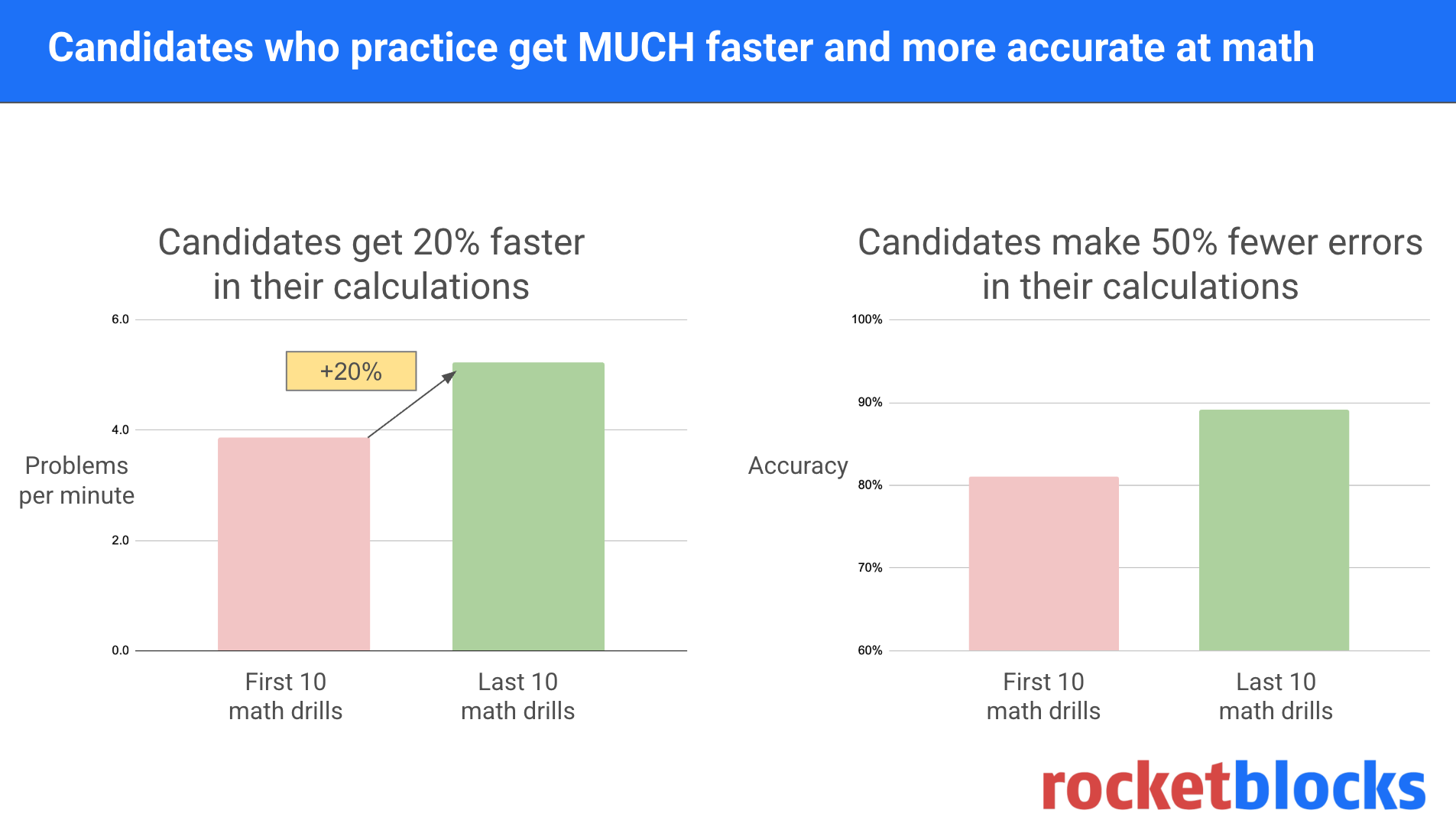
This is a critical point worth emphasizing. These charts demonstrate that YOU can improve at this skill. The former English teacher pursuing their MBA who hasn't done math in nine years? He can improve. The marketing writer transitioning into product? She can improve. Math is not some innate biological trait that certain people possess and others lack. It's a learnable, practicable skill that is within your control to master.
Step 1: Benchmark your current mental math skills (Top)
At the outset of your practice, it's important to benchmark your overall math abilities. RocketBlocks' mental math benchmarking drill (subscription required) takes less than 15 minutes and is designed to assess your knowledge of different calculation types you might encounter in a case interview. Upon completion, we'll return results including expert answers and a customized path forward based on your performance so you can continue perfecting this crucial skill.
Step 2: Improve your ability to set up math questions (Top)
Use math setup drills to practice converting given data into equations you can then solve. Here are two examples of setup drills to give you a preview:
Can it
Given growth forecasts for the next five years, help a manufacturer calculate the number of cans it can expect to produce in the future.
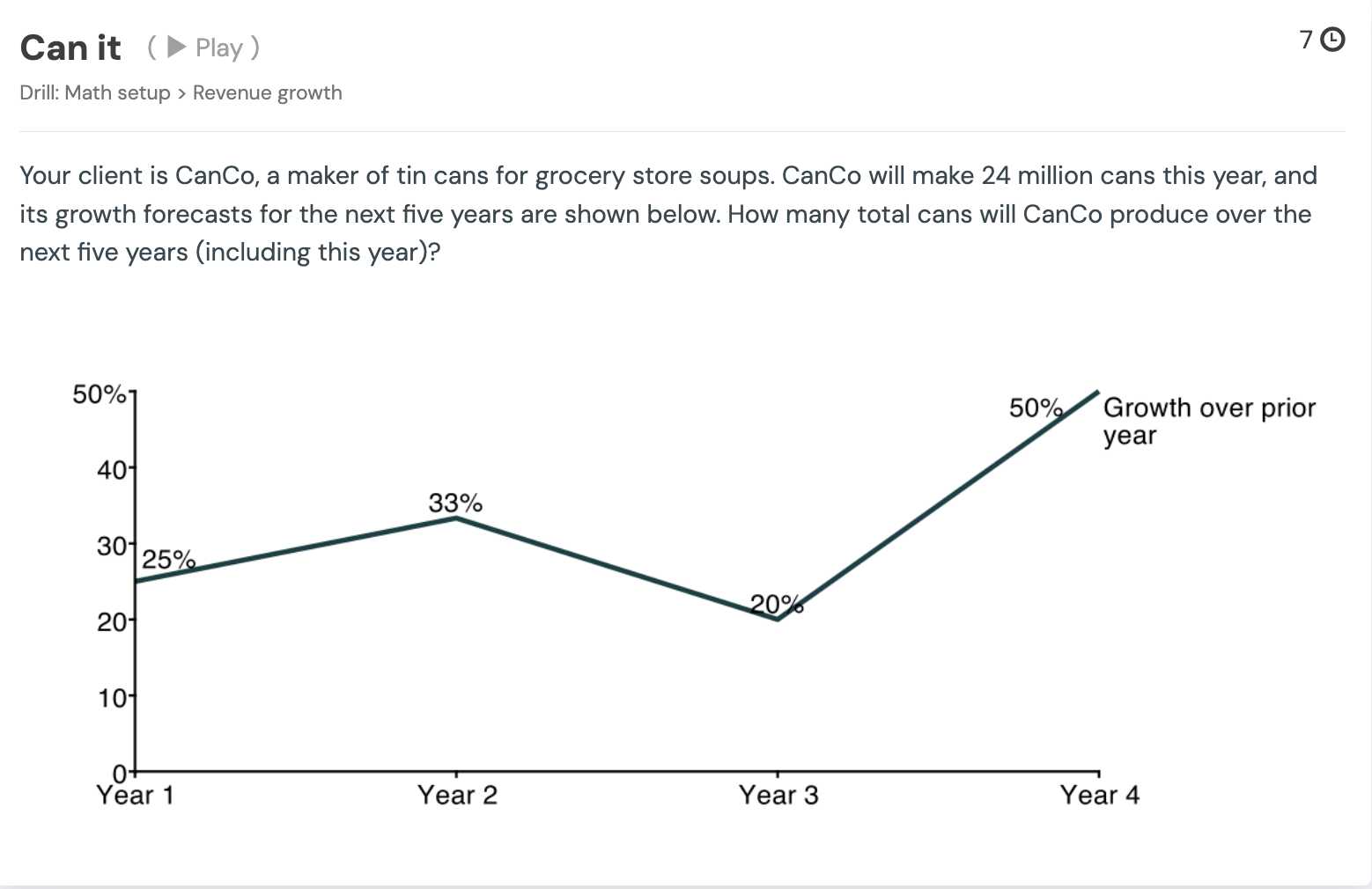
View the Can it drill.
Orange You glad?
Help an orange juice producer determine which variety of fruit produces the most juice per acre.
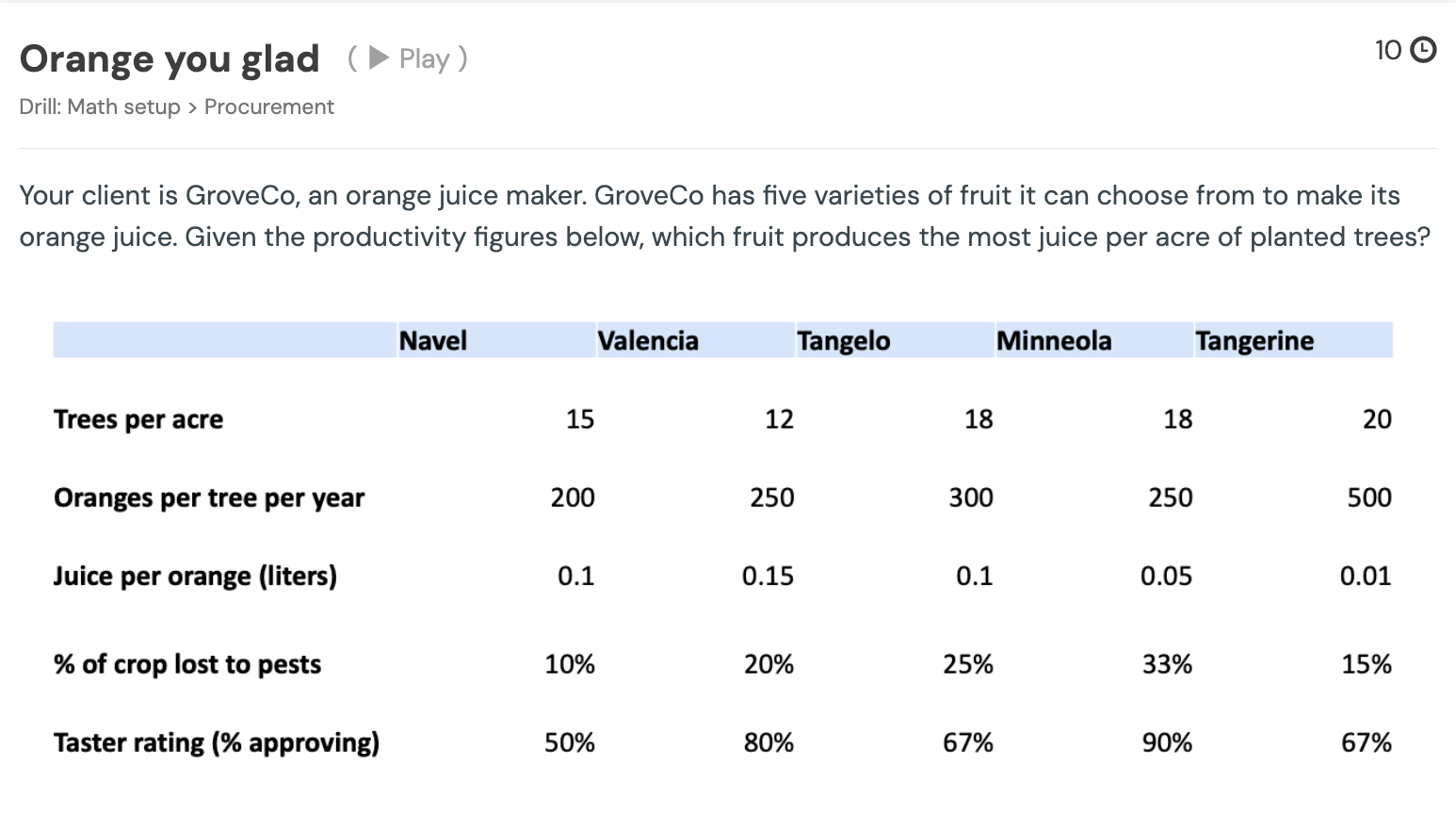
View the Orange you glad drill.
When you complete each drill, you'll get a walkthrough of the math from one of our RocketBlocks Experts.
Step 3: Master calculation techniques (Top)
Deliberate practice involves learning theory and then applying that theory through execution. To improve at calculation, study our tips, tactics, and techniques for speedy and accurate math in our Mental Math Concept guide and watch our mini-lesson on improving mental math speed and accuracy.
This content will familiarize you with methods that make working with large, messy numbers significantly easier.
Division: The magic of factoring
From our Mental Math Concept guide:
This technique is key to simplifying many messy division problems, and you can apply it to the numerator, denominator, or both.
Factoring the numerator: If you face a problem like 500 ÷ 4, you can factor this into 5 × (100 ÷ 4) and solve. Since (100 ÷ 4) = 25, then 5 × 25 = 125.
Factoring the denominator: Take 500 ÷ 4 again. Another approach is to recognize that dividing by 4 is equivalent to dividing by 2 twice. So 500 ÷ 4 becomes 500 ÷ 2 ÷ 2, or 500 ÷ 2 = 250 and 250 ÷ 2 = 125.
Factoring both: Consider the problem 210 ÷ 42. This can be factored into (30 × 7) ÷ (6 × 7). The 7s cancel out, leaving 30 ÷ 6, so the answer is 5.
You can't learn to be a competitive cyclist by watching the Tour de France, and if you want to improve your mental math case skills, you need to get active. At some point, you'll need to engage your brain and start practicing with real industry problems. That moment is now.
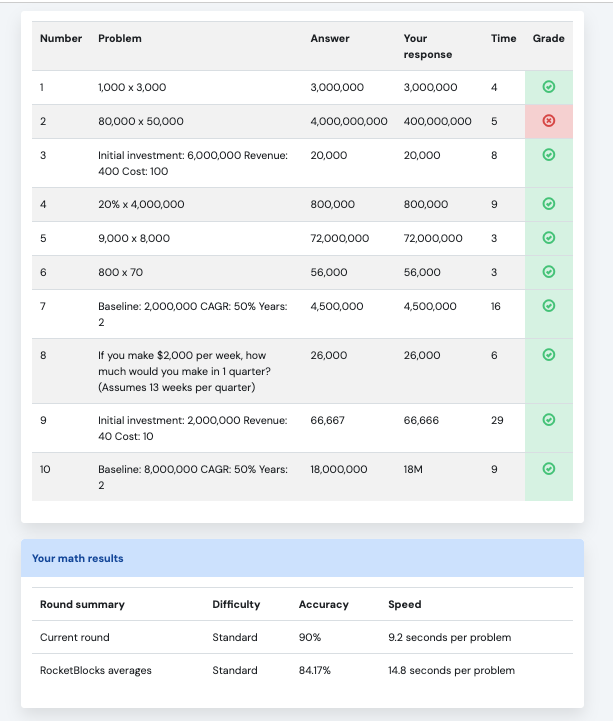
Fortunately, RocketBlocks provides unlimited, algorithmically-generated mental math drills you can use to sharpen your calculation skills. Use these drills to focus on specific skills and increase your comfort level with messy numbers in various formats. At the end of each set, we'll show your results compared against other candidates on RocketBlocks.
Step 4: Strengthen your insight extraction (Top)
Finally, you need to become more adept at extracting business insights from your calculations. Here are several tactics:
First, review our industry overviews to contextualize your numbers. Your calculation shows 20% year-over-year growth? That's quite strong—unless you're a VC-backed company operating in a hypergrowth market.
Next, try the "3-1-2" tactic. Earlier we discussed that quantitative sections of cases typically unfold with setup, then calculation, then insight. But if you want to improve your insights, you can start with your insight before calculating.
Using the dinner calculation from earlier, consider a situation where you have a $500 team budget for dinner. You can begin your quantitative section by stating, "If the cost we calculate exceeds $500, we cannot eat at this restaurant." Only then do you proceed with your calculation.
Similarly, if you're working on a case with a go/no-go investment decision and you're calculating expected revenue, try to determine the revenue ranges and their implications before you calculate. For example, you could establish that if revenue exceeds $100M, you'll definitely invest; $50-$100M only if there's strong strategic alignment; and below $50M you won't invest under any circumstances.
As a bonus, knowing these ranges often simplifies the math you need to complete. You no longer need the exact revenue projection—rather, you're calculating whether it falls into a certain range.
Conclusion (Top)
After spending several hours building your math skills independently, you'll be ready to tackle the quantitative portion of any case. Use our case library or any cases you encounter to practice your skills even further in realistic scenarios.
The combination of isolated skill development through drills and integrated practice through full cases will ensure you're prepared to handle any quantitative challenge your interviewer presents.
Read this next:
- Full cases from RocketBlocks
- The MECE principle
- Be a great mock interview partner
- Mock interview grading templates
- Example case interview prep plans
- Be authentic: advice from a Bain Consultant
- Don't be that candidate
- The Skill Building Loop for case interviews
- Recover from a math error
- Conclude a case interview well
- Acing Accenture's interview process
- How to use RocketBlocks
- Asking great questions in consulting interviews
- How to prep for fall consulting recruiting over the summer
- How to analyze charts in your consulting interview
- Profitability cases: beyond the formula
- How to build CPG industry knowledge
P.S. Are you preparing for consulting interviews?
Real interview drills. Sample answers from ex-McKinsey, BCG and Bain consultants. Plus technique overviews and premium 1-on-1 Expert coaching.


