How to analyze charts in your consulting interview
Master chart interpretation for consulting interviews with benchmarking, frameworks, expert videos, and targeted practice drills

|
|
Benchmark skills | Review core concepts | Gain context | Active practice
Charts and data are everywhere. As kids we read box scores, track character progress in video games, and use weather charts to decide what to wear on a given day. As adults, we get daily hits of interesting data via the news, sports, and fun accounts like Chartr daily.
Chart and data analysis are also core portions of case interviews in consulting and tech. There are two reasons for this:
First, is that once you get hired into an actual job like consulting or product, you'll look at 20 charts a day, sometimes before lunch. Being able to quickly identify the important takeaways from some data is about as important as breathing inside of MBB or FAANG.
Second, is that chart interpretation is an extremely sharp way to test multiple problem solving skills at once. If a candidate can look at a chart, pull out insights, run some numbers in her head, and communicate the implications back to the interviewer inside of 60 seconds, there's a good chance she has what it takes to make it.
The bottom line is that "interpret this chart" is the consulting interview version of "sell me this pen" from a sales interview.
This article features our best resources to strengthen your charts and data muscles, including a concept, our benchmarking tool, drills, and videos. Read on to find out how you can build up this skill for real, so you can be prepared when you get to the interview room and when you get to your desk on the first day in your next role.
First, benchmark your charts and tables skills (Top)
If you're new to case interview prep and/or haven't yet learned the basics of working with charts in case interviews then, don't worry: we've got you!
RocketBlocks' charts benchmarking drill (subscription required) takes less than 10 minutes and is designed to assess your knowledge of different kinds of charts you might see in a case interview. Once completed, we'll return results, including Expert answers and a path forward based on your results so you can continue to perfect this crucial skill.
Next, review the core concepts(Top)
Once you've got your benchmark, you can brush up on the theory by reading our Charts & data Concept (subscription required) and watching our mini-lesson on chart interpretation.
This content will help you get familiarized with why charts are so important, what types of charts are used to visualize which types of problems, why consulting firms and tech companies consider chart generation and analysis a non-negotiable skill, how to effectively clear both basic and advanced charts, and how charts can generate insights that directly circle back to your case goals.
Here's an excerpt from the concept with a definition we like to share to help people who are just starting out on their interview journeys:
Charts and data tables are incredibly powerful, and that's why everyone from consultants to product leaders to executives routinely employ them to make their arguments.
This track will teach you how to pull data-driven insights from charts and data displays. To do that effectively, it will start by helping you understand the types of charts deployed on the job.
More importantly, we will provide insight as to why one type of chart (say, a Marimekko chart vs. a stacked column chart vs. a bar chart) is preferred versus another in any given situation.
Learning the rationale for which charts work for specific scenarios will greatly improve your ability to quickly parse and understand charts.
Third, learn what "great" chart analysis looks like(Top)
Here's another excerpt from our concept with our insights on how to build your chart reading and interpretation skills over time:
When charts and data are presented in case interviews, there are three key things you want to do:
- Orient yourself: understand what's being presented
- Identify trends: call out the key trends illustrated
- Connect the dots: answer the "So what?" implications
In each of these steps, you want to verbalize your process so that the interviewer can follow along. This is why it's critical that you begin with orienting yourself. It doesn't force you to immediately jump to deep insights. However, it allows you to continue a natural dialogue while getting your bearings straight with a new set of data.
Check out these bite-sized videos to see industry Experts employ these three steps on charts in some of our recent cases:
How a BCG consultant analyzes a chart on Nike's economics
How a Bain consultant analyzes a chart on Disney's revenue
Last, actively practice with charts drills(Top)
You can't learn to sing by watching Pitch Perfect and if you want to improve your chart case skills, then you'll need to get active! At some point, you'll need to turn your brain on and start to practice solving real industry problems. (That moment is now!)
Fortunately, RocketBlocks comes with ~100 charts drills. You can use these drills to focus purely on one skill and increase your comfort level with data in many different formats. After you speak (or type) your responses, we'll compare your insights to our Experts as well as provide feedback on how well you verbalized the chart.
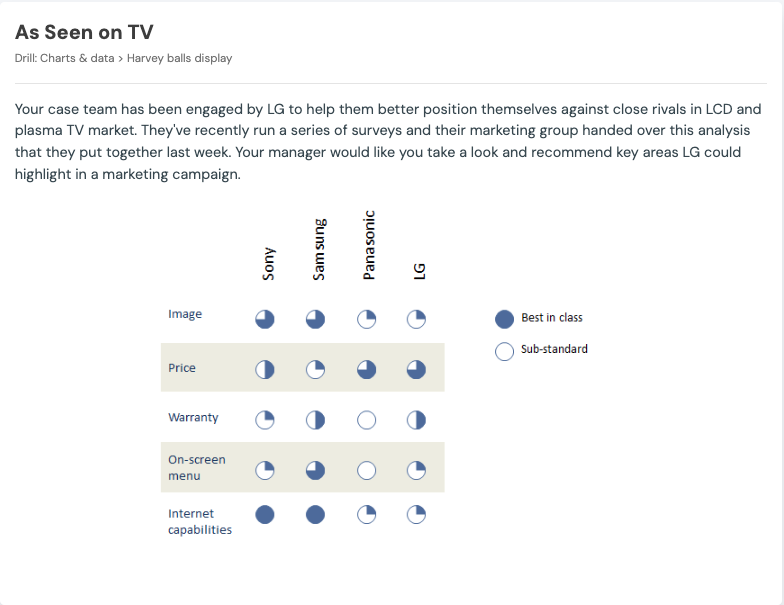
As seen on TV - Help LG get a leg up on the LCD and plasma TV competition.
View the As seen on TV drill.
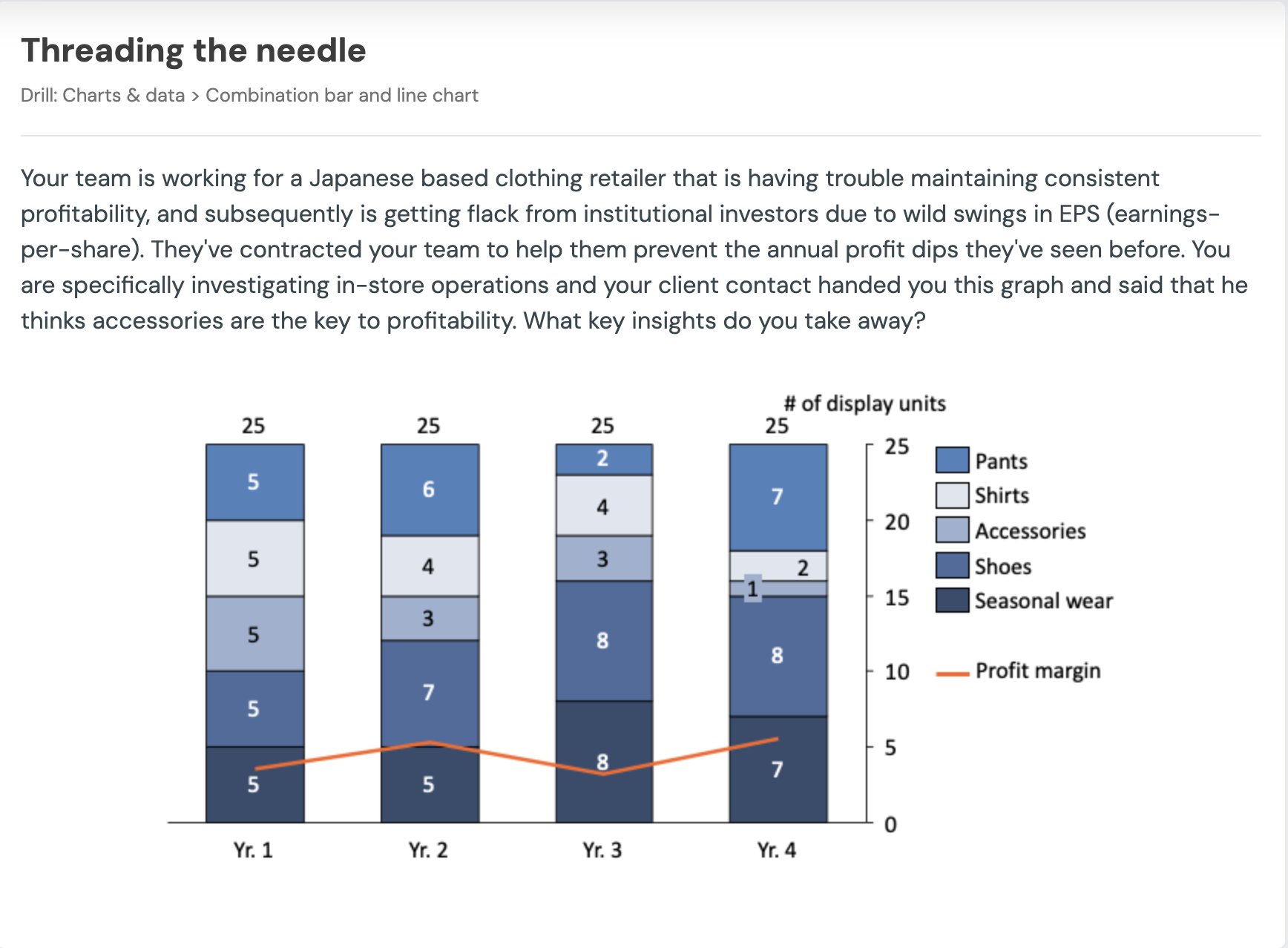
Threading the needle - Can tweaks to in-store operations help reverse a Japanese clothing retailer's annual profits decline?
View the Threading the needle drill.
Boosting output - Help a large industrial goods manufacturer standardize best practices: which outstanding factory should they visit first?
Click here to access this drill.
The hidden costs of success - You've created the chart below to showcase the excellent performance of a major supermarket's in-store promotions team. Highlight the chart's key points to help greenlight the team's revenue-boosting work.
Click here to access this drill.
What's for dinner? - Help a hotdog stand consider the revenue implications of adding a vegan hotdog option to their menu, which hasn't changed in over 20 years.
Click here to access this drill.
Finally, test your skills with live practice
There's no substitute for live practice with a partner; it's the closest you'll get to a real case interview, and live practice is a crucial step in knowing how your visual analysis has progressed and where areas for improvement still lie. Our peer marketplace is the perfect place to look for people who are free to interview, post your available times, and get some live practice in to test out your new skills.
Once you've found a partner, use our case library to pick a fresh business problem and get to practicing your charts analysis skills as well as other foundational skills like structuring, mental math, and more.
Read this next:
- Full cases from RocketBlocks
- The MECE principle
- Be a great mock interview partner
- How to build mental math skills
- Mock interview grading templates
- Example case interview prep plans
- Be authentic: advice from a Bain Consultant
- Don't be that candidate
- The Skill Building Loop for case interviews
- Recover from a math error
- Conclude a case interview well
- Acing Accenture's interview process
- How to use RocketBlocks
- Asking great questions in consulting interviews
- How to prep for fall consulting recruiting over the summer
- Profitability cases: beyond the formula
- How to build CPG industry knowledge
P.S. Are you preparing for consulting interviews?
Real interview drills. Sample answers from ex-McKinsey, BCG and Bain consultants. Plus technique overviews and premium 1-on-1 Expert coaching.


