How to learn an industry in one day: automotive example
Master chart interpretation for consulting interviews with benchmarking, frameworks, expert videos, and targeted practice drills

|
|
Building business acumen | Step 1: Start with a goal | Step 2: Read and consume | Step 3: Practice actively | Step 4: Consolidate learnings | Extend to other industries
Let's say you come from a non-business background*. You're excited about an upcoming interview, but you're also anxious because the people interviewing you have years of experience in business, and you don't. How are you supposed to act like you're on their level of problem solving? What if they see right through you and think you don't know what you're talking about?
This guide is all about how to build business intuition in the run-up to your interviews. Business intuition, aka business acumen, is one of the foundational problem solving skills that top firms are looking for in candidates. To help guide you, we're going to go deep into a specific industry (automotive), and show you how you can build at least some business sense in just one day.
As a bonus, this guide features three full automotive industry cases, each with accompanying Expert mock interviews, all worth a watch to see how your attempt measures up and to easily identify areas that need improvement.
*PS - If you feel “non-business background” describes you or your students, know that rule #1 is don’t describe your background as “non-business.” That’s the least charitable way to label the important and impactful work you have done in your career.
Building Business Acumen (Top)
Like all the skills people build on RocketBlocks, the key to developing business intuition is an organized approach coupled with active, deliberate practice. The advice we often hear career advisers and club leaders share with students is to "read publications like the Wall Street Journal, Lenny's newsletter, or Scott Galloway's podcast/newsletter." This advice is helpful, and consuming this kind of content does work over a long period of time. But it's not structured, it's not efficient and if your interview is in 16 days, it isn't a realistic way to build business sense.
Instead, this guide will give you a structure for learning one industry in just a few hours. Extending from this framework, you can build your business knowledge of 5-10 industries over a few weeks by targeting one industry on any given day. And once you have some understanding of a dozen industries, you can start to pull out patterns, connections and differences from one industry to the next, unlocking your ability to react better if you are faced with a "new to you" industry during an actual interview.
Here is the high level framework for you to follow:
Step 1: Start with a goal and framework
Step 2: Read and consume content
Step 3: Practice actively and deliberately
Step 4: Consolidate your learnings
Step 1: Start with a goal and framework (Top)
Let's be clear - after you follow this lesson you're not going to know enough about the automotive industry to be hired as a COO for Toyota. But you will probably know enough to have an opinion on whether a Honda-Nissan merger is a good idea, and be able to articulate what you'd have to believe for a powerhouse combo like that to make good business sense.
This is important, because certain firms have established automotive practices, such as Bain, McKinsey, BCG and Accenture, and it's not uncommon for candidates at these and other firms to get an automotive-centered case.
The goal for "industry in a day" is to set you up for success if you're faced with this industry in an interview. Specifically, at the end of this exercise you should be able to:
- Ask helpful, clarifying questions at the start of an automotive case
- Develop more nuanced hypotheses for what might be causing problems seen in cases and more targeted plans for how to fix them
- Add more focus and detail to your initial frameworks when solving cases
- Have a few key facts or stories on hand to sprinkle into your case as supporting evidence and anecdotes for your solutions
The framework you'll use to build this knowledge is below. The idea is to fill in your answers over the course of your three hours of study. Skip to the end of this guide to see what it looks like when completed for the automotive industry.
Your research framework

Step 2: Read and consume content (Top)
Great - we've identified our goal and have a framework on hand to organize our work. We're ready to start learning. The best place to start is the industry overviews that are part of your RocketBlocks subscription. These overviews help establish your bearings on industries you're not super familiar with.
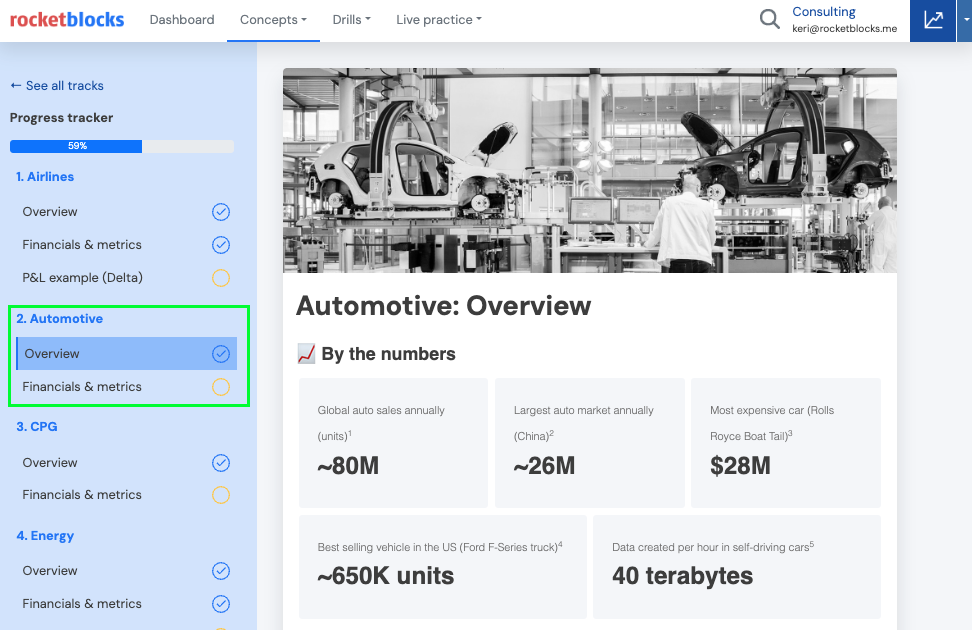
For automotive, specifically, we share top line revenue numbers, recent events, and key industry metrics like fuel economy and dealer network performance. We share information on how to understand the major trends and events shaking up the industry at record pace - hello, autonomous vehicles, EVs, and shared mobility.
From here, you can expand your research by reading up on places like Wikipedia, the Wall Street Journal, and others. WSJ, for example, allows you to view recent news by industries, and you can get a feed of just autos news from the last few months. The key here is to have your framework questions in mind as you read, and be filling in your answers as you go. Importantly, this work is much more targeted, efficient, and impactful than following the blunt advice of "read the Wall Street Journal." In 30 minutes of reading you should be able to identify major auto industry trends (Tariffs! And the threat thereof), and you should have 1-2 talking points that may be relevant in an interview.
Step 3: Practice actively and deliberately (Top)
Unfortunately, you can't learn to ride a bike by reading a book, and you can't learn to solve automotive problems by reading the WSJ. At some moment, you will need to turn your brain on and start actually practicing solving real industry problems. (That moment is now)
Fortunately, your RocketBlocks subscription comes packed with automotive industry drills and cases based on recent industry events.
Automotive Drills
Here are a few fun industry-specific drills on RocketBlocks that will help you hone your auto industry knowledge (and other important skills along the way). We've included the prompts here - log in to see our Expert answers!
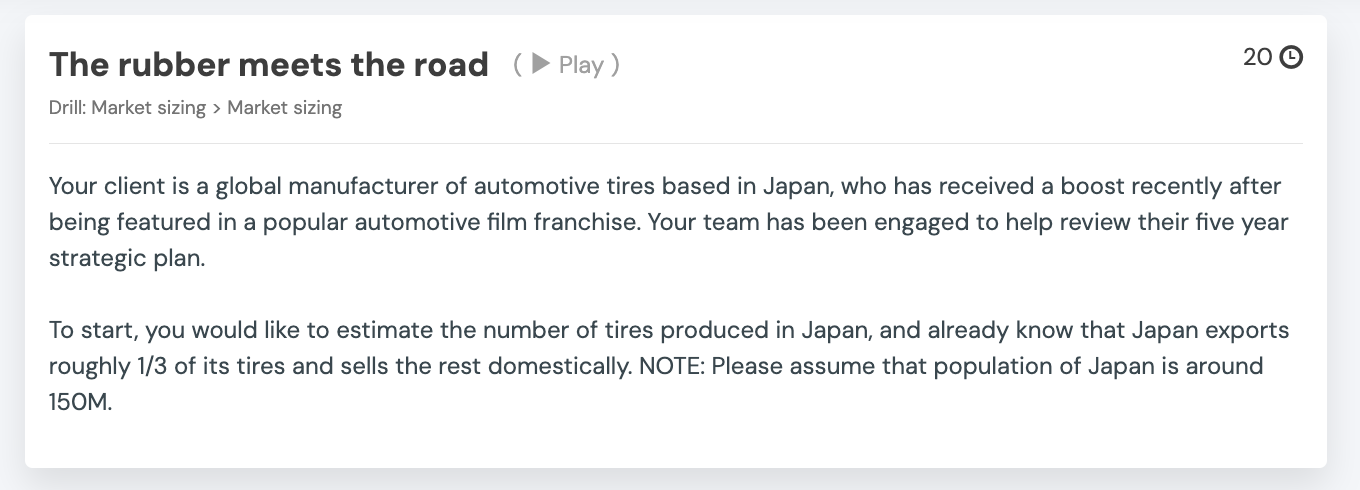
Market sizing - Help a Japanese tire manufacturer review their 5-year strategic plan by first estimating the number of tires produced in the country.
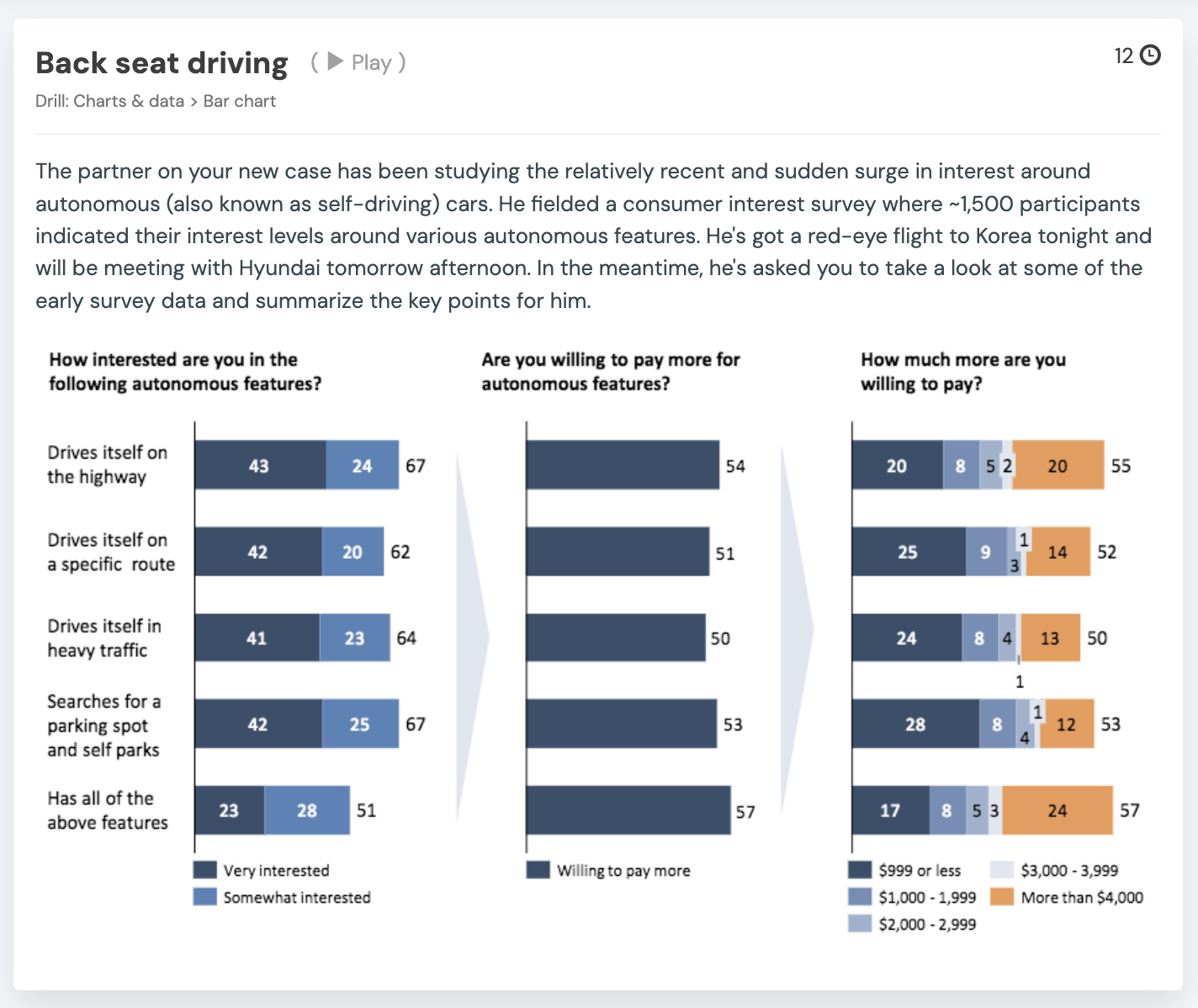
Charts & data - Help your partner prep for a meeting with Hyundai. Take a look at this chart of early consumer research survey data and summarize its key insights for her.
Brainstorm - Highlight some key issues to help your Partner write a new thinkpiece on the impact of EVs.
Structure - Collaborate on a framework to help pitch a grocery delivery business aimed at driving additional revenue for your firm.
Implementation - Help your client, a global automaker, identify the main opportunities and challenges of sourcing more parts from China; is this a feasible cost-cutting strategy?
Full Automotive Cases - PDFs and Expert Mocks
These cases are based on recent, real-world automotive industry events. For each case you can either access a 15+ page peer practice PDF with sample answers from Experts or access a full, drill-by-drill case (subscription required for the latter). For all 3 cases you can watch two of our Experts walk through the case live in a mock interview.
🔌 Competitive responses case: boost EV sales
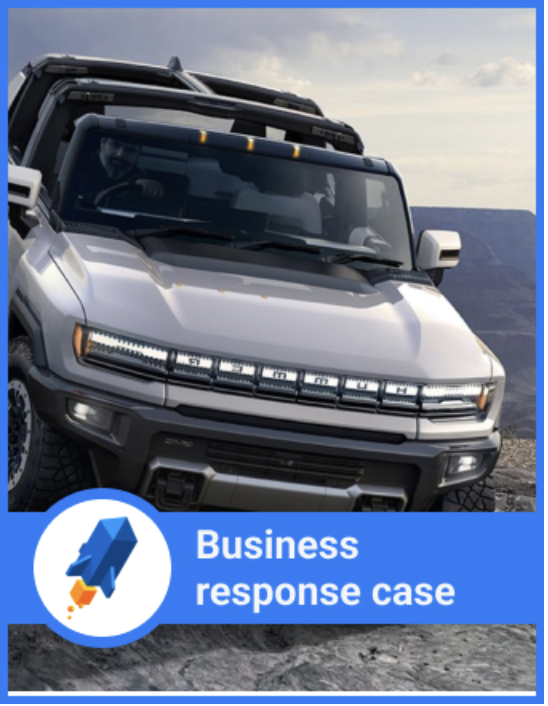
Click here to access the full PDF case and Expert mock video
This case is based on GM's 2023-24 struggles to push electric vehicle sales amidst a headwind of over-performing combustion engine sales. For this case, your client is General Motors, with a long-term goal of phasing out the production of combustion engines by 2035. The case has real data from the last few quarters that shows slower EV sales than expected. Help GM look at their existing strategy and make adjustments to "win" in a choppy and exciting market.
For the expert mock, Watch Abigail Doekson (ex-BCG Consultant) run Ben Wilson (ex-EY Parthenon) through this peer practice case helping GM re-evaluate their goal of transitioning to EVs by 2035 despite declining EV sales.
Want to get coaching with Abigail? Book time on her RocketBlocks page!
Want to get coaching with Ben? Book time on his RocketBlocks page!
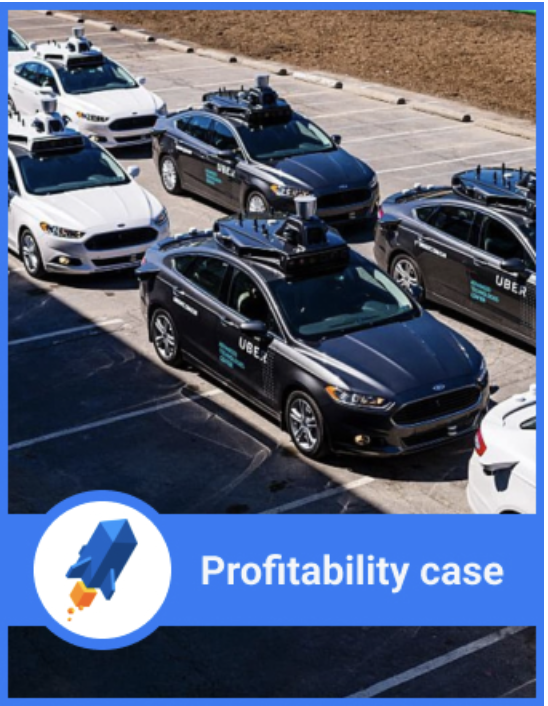
🤑 Profitability consulting case: Should Uber & Waymo team up?
Click here to access the full PDF case and Expert mock video
In Driving for Dollars, your client, Uber, is contemplating a future fleet consisting solely of self-driving vehicles. The company would like to test the model in one city - Austin, Texas - and they've hired your firm to assess the profitability of a major switch like this. On the surface, this case is about profitability, but transforming a massive company's business model will inevitably unearth a few unexpected challenges. Grab a case buddy and get cracking!
In the Expert mock, watch ex-McKinsey Engagement Manager, Rob Reiling, run ex-Bain Senior Associate Consultant, Tessa Peerless, through this profitability case for Uber, evaluating the profitability, operational feasibility, and scalability of partnering with Google's Waymo to launch autonomous vehicles in Austin, Texas.
Want to get coaching with Tessa? Book time on her RocketBlocks page!
🤔 Market entry case interview - risk analysis
Click here to access the full case and Expert mock video
Your client, a Detroit-based auto parts manufacturer, has lost 50% of their stock price in the last few weeks following a spate of analyst coverage touting the risks of self-driving cars to the long-term prospects of the industry. The CFO has asked for your help to understand the risks to his business. What approach do you take to evaluate his question?
For the Expert mock - Watch Christopher MacRae Ham (Ex-BCG Project Leader) run Eishan Dhandhania (Bain Consultant) through this market analysis consulting mock case interview.
Want to get coaching with Chris? Book time on his RocketBlocks page!
Step 4: Consolidate your learnings (Top)
Don't stop now. Once you've finished reading, completing drills, and walking through a few mock cases, you are in a prime position to consolidate your learnings about the industry and make sure you are ready to go for an automotive industry case. This is an important moment, and you can't let it slip away. See below for how one candidate might summarize their learnings on the auto industry using the framework we shared above.
Example: Consolidated automotive industry knowledge
Here's what the completed framework might look like:
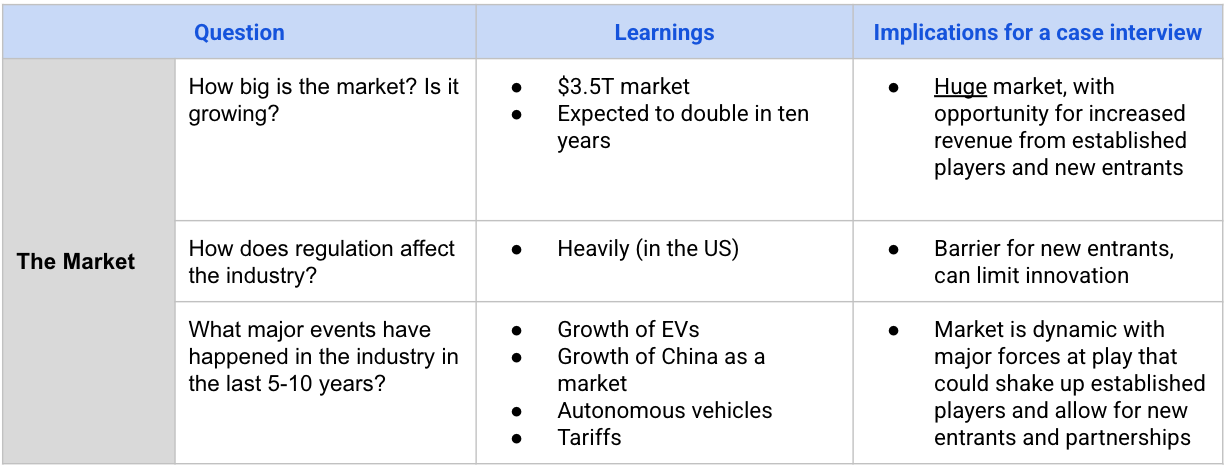
The Market
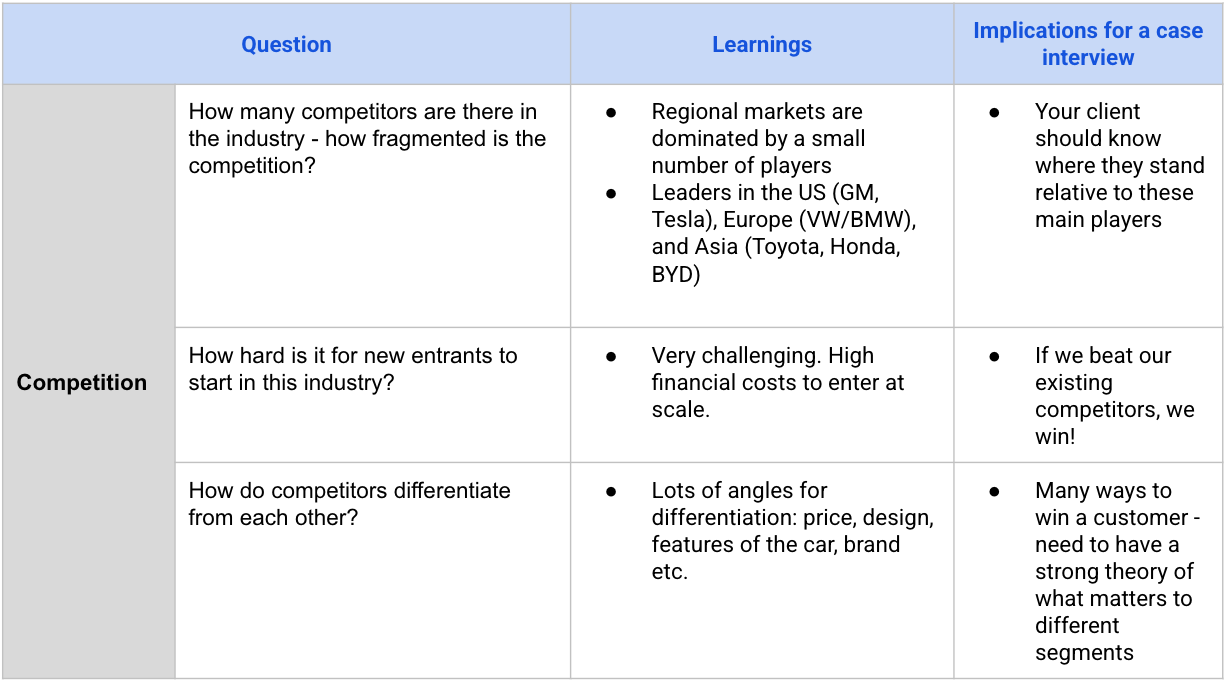
Competition
Company
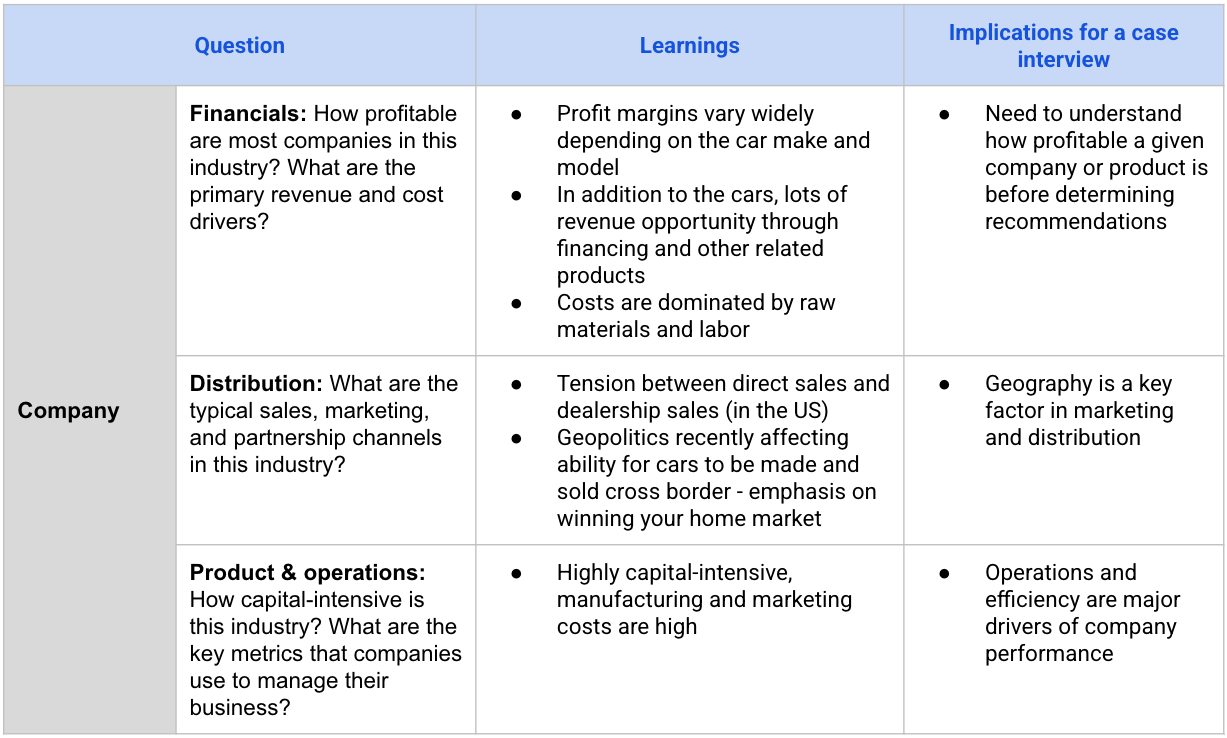
And that's it. After just three hours of study on the automotive industry, you now have a sense of how the industry works, recent events, and some jumping off points for likely areas of focus during a case. Lastly, you can enter your interview with a touch of confidence.
Extending this approach to other industries (Top)
The framework you've just learned isn't specific to automotive. You can build your business knowledge of 5-10 industries over a few weeks by targeting one industry on any given day. And once you have some understanding of a dozen industries, you can start to pull out patterns, connections and differences from one industry to the next, unlocking your ability to react better if you are faced with a "new to you" industry during an actual interview.
Consider dedicating a day to each of these industries based on your interview timeline:
- Automotive (completed)
- Retail / E-commerce
- Healthcare / Pharmaceuticals
- Financial Services / Fintech
- Technology / SaaS
- Consumer Packaged Goods
- Energy / Renewables
As you build knowledge across multiple industries, you'll start recognizing patterns: how different industries approach pricing, what drives profitability, how technology disrupts traditional models, where regulation plays a major role.
Pick an industry, set aside a few hours, and start building the business intuition that will help you succeed in your interviews.
P.S. Are you preparing for consulting interviews?
Real interview drills. Sample answers from ex-McKinsey, BCG and Bain consultants. Plus technique overviews and premium 1-on-1 Expert coaching.


